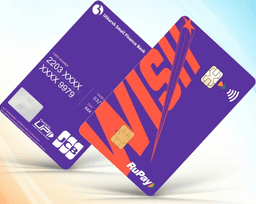
Utkarsh Wish Review 2026: 3% on PhonePe Bills — Capped at ₹500 a Month
Utkarsh Wish is a PhonePe co-brand paying 3% on bill payments and utilities through PhonePe. The ₹500 monthly UPI cap binds at about ₹16,700 of bills. Full review and FAQs.
Utkarsh Wish is a PhonePe co-brand, backed by a fixed deposit, with no joining or annual fee.
It pays 3% on bill payments and utilities through PhonePe — its headline, and the highest rate Utkarsh publishes on any card.
Utkarsh Wish Credit Card Quick Overview
| **Card type** | Entry cashback co-brand |
|---|---|
| **Best for** | Someone who pays their bills through PhonePe every month |
| **Joining / renewal fee** | ₹249 + GST joining, Nil + GST renewal |
| **Network** | RuPay, Visa |
| **Base reward rate** | **1.0%** |
| **Top reward rate** | **3.0%** — utility |
| **Reward currency** | Cashback, valued at ₹1 each |
| **Lounge access** | None published |
| **Forex markup** | 3.5% |
Reward Structure: How You Earn
3% rewards on bill payments and utilities paid through PhonePe.
1% on select brands via PhonePe.
1% on all offline merchants paid by Scan & Pay through PhonePe.
One thing this review deliberately ignores. Every Utkarsh credit card page shows the line '1 reward point on every ₹100 spends on debit card' under a 'Rewards' heading. That is a debit card promotion displayed on the credit card pages — it appears identically on all five — and it is not this card's earn rate.
| Spend | Effective rate |
|---|---|
| utility (capped at 500 points a month) | **3.0%** |
| Everything else | 1.0% |
| Fuel, rent, wallet loads, government, gaming | **0%** |
The caps that actually bind
Headline rates mean little until you know where they stop. These are the limits on this card:
| Cap | Limit |
|---|---|
| Upi | 500 points per calendar month |
Every band requires PhonePe
There is no general earn rate on this card. All three bands are conditional on the transaction going through the PhonePe app — bills, select brands, and Scan & Pay at offline merchants. Spend the same money anywhere else and Utkarsh publishes nothing that you earn.
The 3% runs into the ₹500 ceiling quickly
PhonePe bill payments are UPI transactions, so the ₹500 monthly UPI cap applies — not the ₹10,000 non-UPI one.
At 3%, ₹500 is reached at about ₹16,700 of bill payments a month. Beyond that the band returns nothing. For a household paying ₹8,000 of utilities monthly the cap never binds; for one paying rent or school fees through PhonePe it binds immediately.
Two cashback ceilings, twenty times apart
| Transaction type | Monthly cap |
|---|---|
| **UPI** | **₹500** |
| Non-UPI | ₹10,000 |
Which one binds depends on how you pay, not what you buy. At 1%, the ₹500 UPI ceiling is reached at ₹50,000 of UPI spending a month; the non-UPI ceiling would need ₹10 lakh.
On Utkarsh's UPI-oriented cards, the small ceiling is the one that matters.
The card's rates are not where you would look for them
Utkarsh's Wish page has a 'Rewards' heading that displays the range-wide debit-card promotion rather than this card's own bands. The actual rates appear further down, in the answer to 'What are the features/rewards associated with Wish Utkarsh SFB Credit Card?'
Fixed-deposit backing decides the card fee
Utkarsh sets the card fee by the deposit you hold at issuance and through your first 12 months. An eligible fixed deposit of ₹10,000 or more means no card fee at all. A reduction in the deposit during that window can bring the fee back.
Charges
Interest rose on 21 June 2026 from 3% a month (36% a year) to 3.5% a month (42%) on unpaid dues.
But cash advances got cheaper a month earlier. Effective 21 May 2026, ATM withdrawals and transfers to a bank account are charged 2.5% a month (30%) — less than the rate on unpaid purchase balances. That is the reverse of the position at every other issuer in this dataset, where cash advances are the most expensive money you can borrow.
Cash advance fees are 5% or ₹25 domestically, 5% or ₹500 internationally. The interest-free period is up to 45 days.
Minimum amount due is 5% of the outstanding, plus any previous unpaid minimum, plus all EMI instalments due, plus 100% of fees, interest and taxes.
Category Restrictions: Where You Won't Earn
- Where you earn nothing: Fuel and cash withdrawals earn no cashback.
- Point expiry: Not applicable — this card pays cashback, which is credited rather than accrued.
- Upi cap: Cashback on UPI transactions is capped at ₹500 per statement month.
Fees and Charges
| Charge | Amount |
|---|---|
| Joining fee | ₹249 + GST |
| Renewal fee | Nil |
| Finance charges | Set per card: 2% a month (24% a year) on Rhodium, 3% (36%) on Eternal, 3.6% (43.2%) on SmartGen, and 3.5% (42%) on Wish and superCard following the 21 June 2026 revision. Utkarsh prices interest inversely to the annual fee. |
| Interest-free period | Up to 50 days on Rhodium, Eternal and SmartGen; up to 45 days on Wish and superCard. |
| Minimum amount due | 5% of the outstanding amount, plus any previous unpaid minimum dues, plus the entire amount of any EMI instalments due, plus 100% of fees, interest, charges and taxes. Where the total amount due is ₹100 or less, the minimum amount due equals the total. |
| Cash advance fee | 5% or ₹500, whichever is higher, on Rhodium, Eternal and SmartGen. On Wish and superCard, 5% or ₹25 whichever is higher domestically, and 5% or ₹500 internationally. |
| Cash advance interest | On Wish and superCard, 2.5% a month (30% a year) for ATM withdrawals and transfers to a bank account, effective 21 May 2026 — LOWER than the 3.5% charged on unpaid purchase balances, which is the reverse of the usual position. On the other cards, charged at the card's revolving rate. |
| Forex markup | 3% on Rhodium, Eternal and SmartGen; 3.5% on Wish and superCard. Utkarsh's Key Fact Statements describe the 3% as applying 'using Visa currency conversion' even on cards whose stated association is Mastercard or RuPay — an internal inconsistency in the documents. |
| Late payment | ₹500 flat on Rhodium, Eternal and SmartGen. On Wish, 10% of the outstanding amount capped at ₹1,250. On superCard the charge is tiered by credit limit: nil below ₹100, 5% of the outstanding below ₹2,000, and 10% capped at ₹1,250 at ₹2,000 and above. |
| Overlimit | ₹500 or 2.5% of the over-limit amount, whichever is higher, minimum ₹500. |
| Fuel transactions | Fuel surcharge is levied by the merchant's bank rather than by Utkarsh. A 1% surcharge refund applies on transactions between ₹400 and ₹5,000. |
| Reward redemption | Not applicable — cashback is credited against the statement. |
| EMI processing | Wish and superCard have separate Transaction EMI terms; the processing fee is not stated in the readable sources. |
| GST | 18% on all fees, charges and interest. |
Is the Utkarsh Wish Credit Card Worth It?
The ₹249 physical card fee is avoidable twice over — Utkarsh waives it where an eligible fixed deposit of ₹10,000 or more is maintained, and a cardholder who stays virtual does not pay it either.
Model your monthly PhonePe bill volume against ₹16,700 before treating this as a 3% card.
Late payment is 10% of the outstanding, capped at ₹1,250 — proportional rather than flat, unlike the ₹500 on Utkarsh's fee-bearing cards.
The forex markup is 3.5%.
Frequently Asked Questions (FAQs)
What does Utkarsh Wish pay on PhonePe bill payments? 3% rewards on bill payments and utilities made through PhonePe. Because those are UPI transactions, the ₹500 monthly UPI cashback cap applies — reached at roughly ₹16,700 of bill payments a month.
Does Utkarsh Wish charge a fee? No joining or annual fee. A ₹249 plus taxes physical card fee applies on applying for a physical card, waived where an eligible fixed deposit of ₹10,000 or more is maintained.
Is there a cap on Utkarsh credit card cashback? Yes, and there are two. Cashback on UPI transactions is capped at ₹500 per statement month; cashback on non-UPI transactions at ₹10,000. On UPI-focused cards the ₹500 ceiling is the binding one.
Which Utkarsh credit card has the lowest interest rate? Rhodium, at 2% a month (24% a year) — roughly half what SmartGen charges at 3.6% (43.2%). Utkarsh prices interest inversely to the annual fee, so the most expensive card is the cheapest to borrow on.
Cards Mentioned in This Article